Many radio control (RC) enthusiasts of all levels are attracted to tailwheel airplanes (“taildraggers”). The RC planes industry caters to that attraction by offering beginner type small sized taildraggers that are safe and easy to fly by novice fliers. Because of their small size, those planes can be taken off and landed on small space and under ideal ground handling conditions. That is not the case as our members get into larger and more advanced taildraggers that require the use of the partial or full length of our club runway. Those planes bring ground handling, takeoff and landing complexities to the table that requires more finesse and experience than that of a novice RC pilots. It is important to note that when training to fly full scale airplanes, novice pilots are taught to fly on nosewheel airplanes. The FAA considers pilots transitioning to taildraggers as having acquired the experience to deal with a more demanding level of airplanes handling. The FAA Airplane Flying Handbook (FAA-H-8083-38) states the following:
“Due to their design and structure, tailwheel airplanes exhibit operational and handling characteristics different from those of the tricycle-gear airplanes. In general, tailwheels are less forgiving of pilot error while in contact with the ground than the nosewheels.”
In addition to takeoff and landing complexities, full scale taildraggers present the challenge of taxiing them into the runway and the low visibility they typically have. Thankfully, we don’t have to deal with those ground handling issue. We just lift our planes and place them on the runway ready for takeoff. It is while taking off and landing my E-Flite Timber X and P-51 1.2 meters wingspan airplanes, that I have experienced handling problems. Some of them have led to torn landing gears and survivable crashes. This challenge motivated me to delve deeper into this problem. Based on the knowledge I have acquired, I better understand the handling limitations we face with our RC taildraggers. This has allowed me to make better decisions leading to safer and more consistent takeoffs and landings with both planes. I have been asked to share my findings with the members of our club and I’m very happy to do so via this paper.
For accuracy, most of the technical information I have provided in this paper, is based on the information available in Chapter 13 - Transition to Tailwheel Airplanes of the FAA Airplane Flying Handbook. I have carefully adapted it to my taildraggers flying reality and I provide my comments related to such adaptation. This paper assumes that the reader has a basic knowledge of takeoff and landing techniques. As such, I will point out the added complexity that taildraggers bring to the table per the handbook and ways to handle them. Many of our members are very competent taking off and landing their RC taildraggers. If this paper provides additional insight to them, even better! For those who are in need of that knowledge, it is my hope that this paper provides valuable information that makes their handling of those tricky planes more enjoyable.
Nuances of Tailwheel Airplanes Handling
By Joseph Vilella
The Taildraggers Handling Challenges
There are three basic full scale taildragger handling challenges that impact the handling of our RC taildraggers. They are weathervaning, propeller induced gyroscopic precession and ground loops. I will discuss the causes of each one of those issues and their potential effect on an RC taildragger takeoffs and landings.
Weathervaning
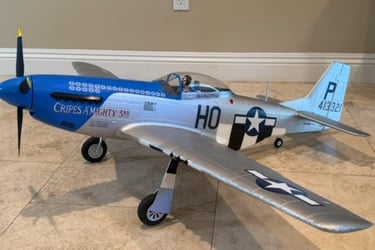
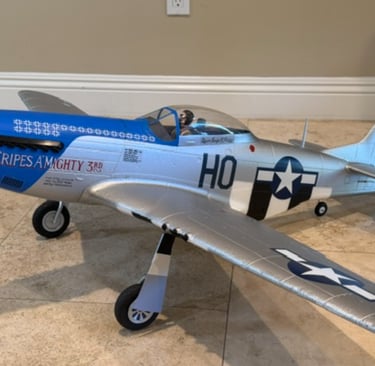
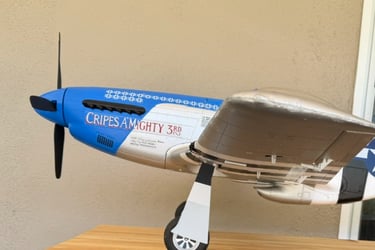
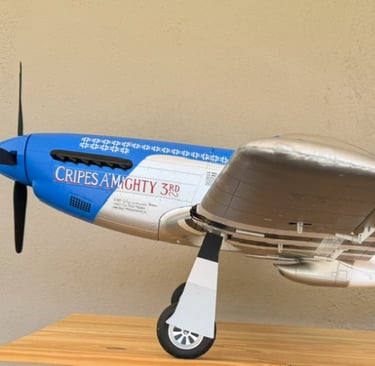
The landing gear of a taildragger, such as that of the P-51 depicted above, is designed so that a triangle is formed between its two front wheels and its tailwheel. It is within this triangle that the plane sits at rest and moves on the ground in a nose high attitude. The front wheels of the taildragger are placed slightly ahead of its Center of Gravity (CG), creating a condition whereby when a side force is applied to its tail, it is very easy for it to pivot around.
When a force produced by the wind hitting the side of a taildragger as its tailwheel is moving on the ground or lifting off the ground, is strong enough, it will cause the airplane to pivot until it turns into the wind. This phenomenon is called “weathervaning”. “Tailwheel airplanes have an exaggerated tendency to weathervane or turn into the wind when operated in the ground in crosswinds” (FAA Manual). This happens to full scale taildraggers while dealing with crosswind and it is an even bigger issue with our very light RC taildraggers. In addition and to complicate matters, when crosswinds hit the wing facing them with enough force, they get under it and nudge it to further support the weathervane. So you have the tail and wing facing the crosswind being used to produce the weathervane.
On light planes like ours, it doesn’t take too much of a crosswind speed to cause a 90 degrees weathervane. My 1.2 Meter P-51 weights 9 ounces, my 1.2 Meter Timber X weights 13 ounces. I have experienced 90 degrees weathervaning with both planes in crosswinds of around 2 mph. I also experienced 90 degrees weathervaning with the Timber X while attempting to takeoff on SAFE on a crosswind of that speed. SAFE does not prevents weathervaning.
Gyroscopic Precession (GP)
As a taildragger nose tilts down from the initial takeoff position with the tailwheel on the ground...
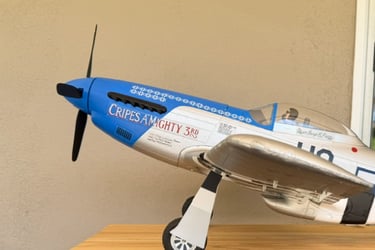
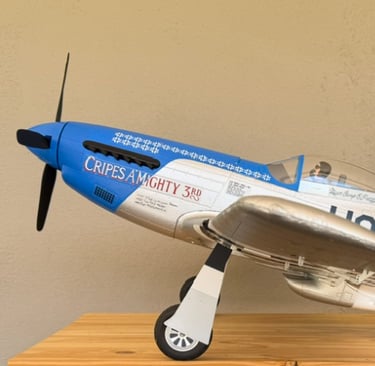
...to the final takeoff position when it is ready to lift off...
Groundloops
Finally, we have the issue of the landing ground loops. If the tailwheel is not properly contacting the ground as you are rolling during your landing, depending on the touchdown severity of the front wheels, or the direction of the wind hitting the runway, you will get into a ground loop. Ground loops into our grass are not a big deal and we have barriers to deal with the ones that come towards the pits, but it would be very nice to not to have to deal with them.
Potential RC Solutions to These Problems
Full scale taildraggers have a larger mass and thus, they are better equipped to deal with crosswinds unless they are considerably severe. In addition, full scale taildraggers pilots can lock their tailwheels centered and independent from their rudder. That is extremely helpful to deal with weathervaning and GP issues because they can produce a straight initial takeoff roll and at the same time compensate with rudder for any weathervaning and GP issues. In addition, full scale taildragger pilots can minimize the GP issue by carefully controlling the nose pitching attitude of their plane as the tail lifts of the ground. In addition, if they feel that the crosswind facing wing is lifting, they can apply the required aileron pressure to keep it down. In essence, they are much better equipped to deal with these two takeoff issues than we are because the are seating inside the plane and can feel and control those changes as they are happening.
That is not our reality in RC flying. We know that the negative events can happen, however, its very hard to predict the speed and intensity at which the events will happen. We are not seating inside or planes. Our tailwheel is attached and controlled by our rudder. We are forced to keep that tailwheel straight while it is on the ground the appropriate time. We cannot and should not rush the tailwheel roll because we need to develop slipstream speed to make our rudder effective and to properly control the effectiveness of our elevator. In other words, we are one step behind the full scale guys. They can perform gradual rudder application as they are accelerating on their centered tailwheel. We cannot move our rudder or we will be changing the direction of our tail on our tailwheel run. So we are in a quandary. We can observe the events happening, however, depending on the circumstances, those events do happen extremely fast and do not give us the proper time to accurately react to them, this is specially the case for weathervaning.
Dealing with Weathervaning and GP During Takeoff
If you are going to have weathervaning, it will typically happen the moment the tailwheel lifts the ground and it will be quick. It will happen regardless of the fact that you put the plane on SAFE or not, and it will depend on the strength of the wind hitting your tail. It happen with a diagonal wind or a crosswind. So if there is wind during takeoff, the best way to deal with weathervaning is to point your plane directly into the wind before takeoff. That takes weathervaning completely out of the equation and all you have to deal with is the GP. Needless to say, when you align into the wind, make sure that you will have enough runway to do a good takeoff and make sure that your plane does not veer into our Chollas tents in any way. Plan for the safety of our club members at all times. Also, remember that depending on how much runway you need for takeoff, there are circumstances that may not allow you to take off all. This is the case if a crosswind is coming from the South and your takeoff preference is left to right. If your plane does a south facing weathervane, its flight path will be aiming at our helicopters tent.
As for the GP left yaw during takeoff, that is bound to happen with or without any danger of weathervaning, and its effect depends on how fast the nose of your plane pitches down during takeoff. If you can ensure a smooth and slow pitch down of the nose, you should have a manageable GP left yaw to deal with that can be corrected with adequate rudder application. If the pitch down of the nose is very fast, the GP left yaw should be very sudden and pronounced. In other words, more than what you would want to experience. Incidentally, there are times when the GP left yaw could be cancelled by the right amount and wind direction of opposing Weathervaning. Having said that, I always assume I will get a GP left yaw so I’m ready for it.
The way I’m working on controlling the GP left yaw of my planes after having having done some testing is the following:
1. Apply smooth and even throttle during takeoff and let the tailwheel lifting be managed by the increasing flow of air on the tail of the plane. Applying down elevator to tilt the nose during takeoff, can accelerate the nose pitch down, thus causing increased GP left yaw. It can also cause propeller damage.
2. As the plane is accelerating, pay focussed attention on the tailwheel.
3. The moment the tailwheel start lifting off the ground, apply slight right rudder and continue applying the required amount of right rudder to keep the plane from yawing to the left
4. Continue the roll to a nice takeoff.
A slow motion video of one of my best test takeoffs showed that with a very controlled nose pitch of my P-51, a 30% GP left yaw started happening as the nose of the plane was getting close to parallel, not as the tailwheel was lifting of the ground. I purposely did not apply rudder correction, in order to see how the GP left yaw happened under ideal nose pitch down circumstances, and with an ideal headwind takeoff.
That is nice to know because if I start applying slight right rudder as the tailwheel is getting of the ground, I’m adding correction slightly before the GP left yaw happens. With this head start, I should be able to slow the GP left yaw down and ultimately control it without a rush. I will be working on perfecting that timed correction in order to clean up my takeoffs.
Dealing with Ground Loops
Finally we get to the issue of how to prevent ground loops with a taildragger. Per the flight manual, the best way to prevent ground loops with a taildragger is to achieve a nice three point landing and immediately that the plane is on the ground, pulling the stick back to the full up elevator position. This keeps the tailwheel firmly on the ground to achieve the best possible directional control. Use light rudder to guide the plane around via the tailwheel.
Accomplishing consistent three point landings require that the plane achieves a slow and controlled descent flight path, followed by a well timed flare out into landing. Ever since I have independently trimmed flight modes on my transmitter, I can achieve nice three point landings with my Timber X and my P-51. Before this, it was too hard for me to control the landing speed of my planes. Here is how you can get help setting up your independently trimmed flight modes for your transmitter.
Setting Up of Independently Trimmed Flight Modes
John Weaver, the owner of Discount Hobbies and one of the most experienced RC pilots in San Diego, set up my Spektrum NX 8+ transmitter with three independently trimmed flight modes. What he did is he kept the SAFE and AX3S gyro modes on my B switch and used my D switch, which controls the flaps, to give me three flight modes that I can fully trim independent of each other. On flap position 0, I have set up Takeoff Mode trims, which incidentally, I could have set up with takeoff flaps but I don’t really need to or want to. On flap position 1, I have set up my Cruise Mode trims, and on flap position 2, I have set up my Landing Mode trims. I put 30% flaps with no elevator adjustments on it because I’m on my flaps/flight modes switch. I do all the trim adjustments for that landing mode, including its flaps, while I’m up in the air. Once the trims are set, I don’t mess up with them. I simply flip the switch and off I into my landings.
The FAA Manual and other books tell you that you should land at the slowest speed that you can safe and stable fly your plane, allowing a good margin to prevent stalls. I have achieved that with my Landing Mode trims set up. With it, I can fly my planes in a very stable configuration for as long as I want, Both planes are slow enough that they can be easily three point landed. If you want your radios setup for these flight modes, talk to John about them and see if they can be trimmed as such. He has told me that he and his team will be happy to help the members of our club.
Summary
Understanding the taildraggers handling challenges leads to smart, fun and safe flying. For the novice pilot, it provides information that will point to better aircraft purchase decisions. Some things to keep in mind are the following:
If you are not an intermediate or advanced RC pilot, you are better served getting your flight experience with nosewheel airplanes. Once you get the necessary experience, you are ready to tackle the finicky taildraggers.
Even with intermediate experience, it will take a while to get used to handling taildraggers... mostly during takeoffs and landings.
The best thing you can do for yourself, no matter what your experience is, is to have John Weaver and his team set up your transmitter with independently trimmed flight modes. This is awesome!
Taildraggers are subject to weathervaning, gyroscopic precession (GP) and ground loops.
Weathervaning impacts full scale taildraggers as well as our RC taildraggers. It is dependent on the weight of the plane and the strength and direction of the wind impacting it. If the wind is strong enough to cause your plane to weathervane, it will do it if its hitting
the plane cross or diagonally and it will force it to face such wind.
GP causes a left yaw dependent on the rate at which your taildragger pitches its nose
down to the takeoff position.
There are situations where weathervaning and GP can combine to cause a severe action.
The very best way to prevent weathervaning is to line the plane into the wind for takeoff.
Groundloops can be prevented by firmly contacting the ground with the tailwheel after
landing by using up elevator. The ideal way to easily achieve this is immediately after you do a three point landing. Two wheels landings will also work although they can be sketchy if you don’t have proper rudder directional control while the tail is up.
10. Always think of the safety of your club members, especially if the wind conditions are less than ideal for taking off.
11. You may contact me if you have further questions or comments by sending me an email to joevilella@gmail.com. Please put “Taildraggers Paper” on your title line so that I can easily find you in my inbox.
Thanks so much and please take care! Joe Vilella
...it undergoes a phenomena called Gyroscopic Precession (GP). GP induces a left yaw to the taildragger as the nose is pitching down to the takeoff position. Thankfully, the amount of left yaw induced is directly proportional to how fast the nose pitches down. Both of my planes experienced that left yaw. It was more severe and harder to control on the P-51 because of the faster rate at which it acquired its takeoff attitude. My Timber would give the chance to correct its left yaw better, which I do by providing the adequate amount to right rudder. Moving forward, I do my best to slow down the speed at which the Mustang pitches down its nose and I also limit that pitch by providing up elevator trim during takeoff. I will discuss how I do that below within this paper.
The worst case scenario happens when the crosswind and the GP work together to impact your taildragger during takeoff, thus causing a severe weathervaning. Weathervaning and GP DO NOT affect nosewheel airplanes. That is why full scale airplane novices fly nosewheel airplanes, not taildraggers.